CoSDR vs Apollo.io: The True Cost of Scaling Outbound Sales in 2026
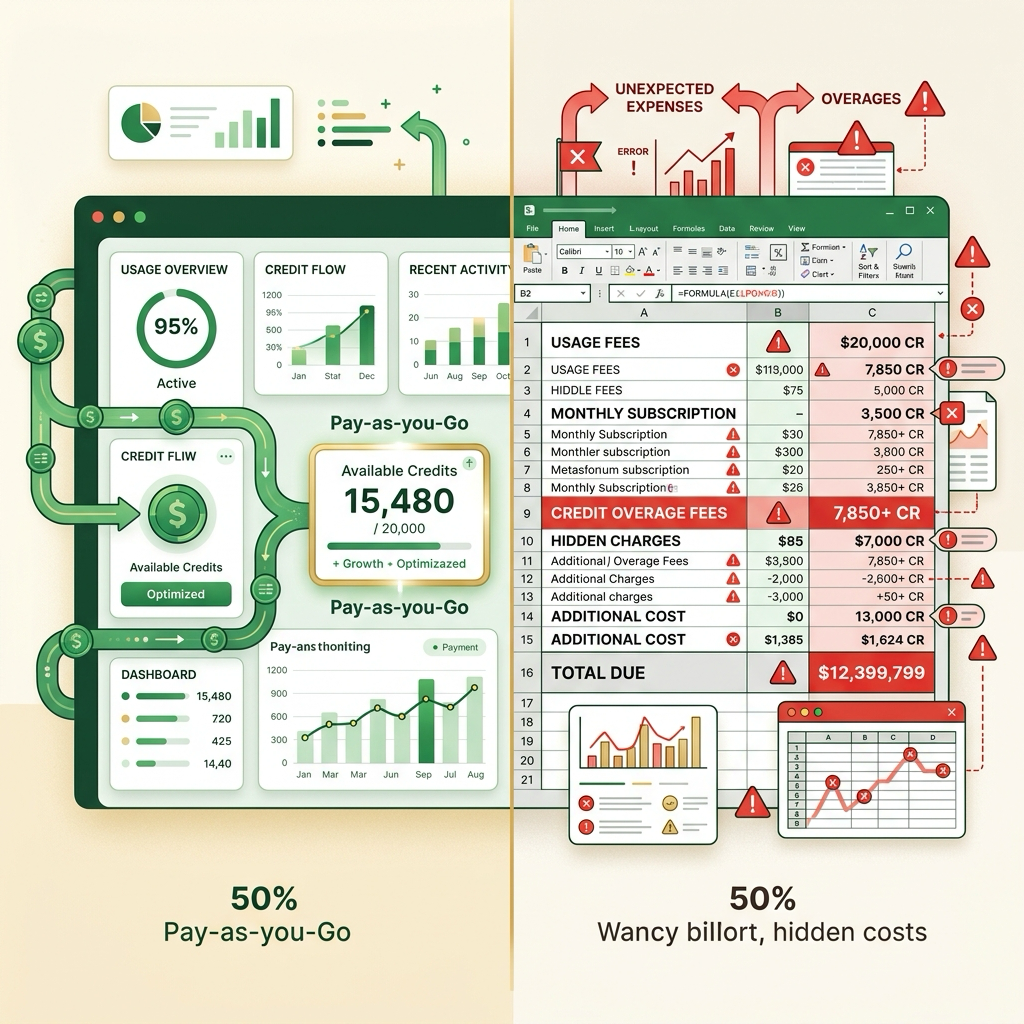
TL;DR Summary"Apollo.io starts cheap at $49 per seat but scales unpredictably through credit overages, mobile number surcharges, and export limits that push real costs past $200 per user monthly. CoSDR eliminates per-seat pricing entirely with a flat $12.49 per 100-company deep scan rate and zero hidden fees."
1. Topic Context & Definition
CoSDR differs from Apollo.io in cost architecture by replacing per-seat subscription tiers and use-it-or-lose-it credit pools with a transparent pay-as-you-go model anchored to actual scan volume.
How Does CoSDR Compare to Apollo.io on Pricing?
CoSDR differs from Apollo.io in cost architecture by replacing per-seat subscription tiers and use-it-or-lose-it credit pools with a transparent pay-as-you-go model anchored to actual scan volume. Apollo.io operates on four subscription tiers ranging from free to $149 per user per month. Each tier bundles a fixed number of export credits that expire monthly. Teams scaling past five seats frequently report total monthly spend exceeding $1,000 before accounting for data quality issues. For a broader platform comparison, see CoSDR vs ZoomInfo.
Apollo.io's Credit System and Hidden Overages
Apollo.io allocates between 100 and 4,000 export credits per user depending on the plan tier. Mobile phone number reveals consume additional premium credits beyond the base allocation. When a team exhausts monthly credits mid-campaign, Apollo forces either a plan upgrade or a pause in outreach activity. Credit rollovers are not available on standard plans. This use-it-or-lose-it structure penalizes teams with variable outbound volumes and creates budget forecasting difficulties. CoSDR avoids this entirely by charging a flat rate per scan batch with no expiration dates on purchased credits. Learn how this impacts lead sourcing workflows in our B2B Lead Finder guide.
Shared IP Contamination and Deliverability
Apollo.io runs email sequences through shared sending infrastructure. Because thousands of accounts operate on the same IP pools, the deliverability of any single team depends on the collective behavior of all users on that shared infrastructure. If neighboring accounts trigger spam filters through aggressive sending patterns, your domain reputation suffers by association. Industry research shows Apollo users reporting real-world bounce rates between 8% and 26% depending on list quality and target region. CoSDR eliminates this risk entirely through its human-in-the-loop copy-paste outbox architecture. AI-generated drafts are presented in a local dashboard where representatives manually copy and paste each message through their own authenticated email client, keeping sender reputation under the team's direct control. This is the same principle detailed in our CoSDR vs Clay analysis.
Data Accuracy Under Scale
Apollo.io maintains a database of over 270 million contacts. This massive breadth creates a precision problem: corporate contact data decays at roughly 30% per year due to job changes, company restructuring, and email domain migrations. Apollo's internal verification layer catches some stale records but consistently misses recently deactivated inboxes. Many experienced sales teams report that exporting raw Apollo lists and running them through a separate third-party email verifier is a necessary additional step and cost. CoSDR takes a fundamentally different approach: instead of blasting a raw export automatically, every drafted message is routed to a human-in-the-loop dashboard where a rep reviews and sends it manually, so a stale record never turns into an automated bounce. Our earlier article on CoSDR vs Apollo covers the technical differences in more depth.
Budget Comparison for a 5-Person Sales Team
Consider a growth-stage startup with five SDRs running outbound campaigns. On Apollo.io Professional at $99 per user monthly, the base cost is $495. Adding mobile number credits, CRM integration add-ons, and a third-party email verification service to compensate for data decay brings the realistic monthly spend to $800 to $1,200. On CoSDR, the same team uses a shared workspace with no per-seat charges. Scanning 500 companies per month costs $62.45 in scan credits. Email drafts are generated by parallel AI agents and delivered to the copy-paste outbox at no additional cost. The total monthly spend stays under $100 for equivalent outbound coverage. Teams can verify this pricing on the CoSDR Platform directly.
When Apollo.io Still Makes Sense
Apollo.io provides genuine value for solo SDRs and very early-stage teams with minimal budgets. The free tier offers basic database access and 100 monthly search credits at zero cost. For individual contributors who need quick list building without advanced verification or personalization, Apollo remains a practical starting tool. The platform's native CRM sync with Salesforce and HubSpot also reduces integration overhead for teams already embedded in those ecosystems. However, once a team scales past three seats or requires precision outbound with protected sender reputation, the economics shift decisively toward CoSDR's architecture. Read about AI B2B Sales Agent best practices to understand why signal-anchored prospecting outperforms static database pulls at scale.
| Metric | CoSDR Platform | Apollo.io |
|---|---|---|
| Base Pricing | $12.49 per 100-company scans (no per-seat fee) | $49–$149 per user per month (tiered) |
| Credit Expiration | Never — purchased credits persist indefinitely | Monthly expiration with no rollover |
| Email Sending Model | HITL copy-paste via local email client | Shared IP automated sequences |
| Deliverability Risk | Near-zero — human sends each message individually | 8%–26% on raw exported lists |
| 5-Seat Team Monthly Cost | Under $100 for 500 company scans | $800–$1,200 including add-ons |
| Third-Party Verification | Not needed — no automated sending to verify | Required — additional $50–$150/month |